
Guides · Haryana and NCR
Lal Dora formalisation in Haryana and NCR: the complete 2026 guide.
What the 2026 law and the 90-day Swamitva campaign cover, what they leave out, the step-by-step process on both the rural and the urban-village track, the legal and tax risks, and when to call a lawyer or CA.
Haryana is turning Lal Dora possession into recorded ownership on two separate legal tracks: a new Act for rural villages and a municipal policy for urban villages such as those in Gurugram. Which track a property sits on decides the owner’s rights, paperwork and deadline, and neither track approves a building.
The full guide is below, free to read. Where the law is unsettled, it says so and tells you whether to ask a property lawyer, a CA or another expert.
What the guide covers.
- The short answer
- What is Lal Dora land?
- Two tracks: rural Abadi Deh Act vs municipal Lal Dora policy
- The rural process, step by step
- The municipal process for urban villages (Gurugram, Manesar and other cities)
- What is covered and what is excluded
- Documents checklist
- Legal complexities and risks
- Buying or investing: due diligence and pricing the discount
- Owners: what to do in the 90-day window
- Bank loans against Lal Dora property
- Stamp duty, capital gains and GST
- When to call a lawyer, CA or other expert
- How Delhi and UP compare
- Frequently asked questions
- Glossary
- Legal references and sources
Get the PDF.
Free. The same guide as a PDF to keep and share. We email you a private link.
Questions about this guide? Write to Anant Shukla, Founder and Principal, at info@asiainvestorssociety.com.
The short answer
Haryana is turning Lal Dora (abadi deh) possession into recorded ownership on two separate legal tracks, and which track your property sits on decides your rights, your paperwork and your deadline.
- Rural villages (outside municipal limits): governed by the Haryana Abadi Deh (Vesting, Recording and Resolving of Ownership Rights) Act, 2025, published as Haryana Act No. 4 of 2026, and its Rules notified on 17 August 2026. The Swamitva Portal went live on 17 November 2026 and a 90-day claims-and-objections campaign started on 18 November 2026.
- Urban villages (inside a municipal corporation, council or committee, e.g. Gurugram or Manesar): governed by the Urban Local Bodies Department policy and SOP of 12 March 2024. It needs proof of 10 years' possession and runs on 30-day objection windows set by each municipality.
- What the paper does: it records who owns the land and structure. It does not sanction the building, give an Occupancy Certificate (OC) or legalise commercial use such as a PG.
- What the cut-off means: under the rural Act, the person recorded is the one in permanent, owner-like possession on 8 March 2019, adjusted for lawful inheritance, gifts and transfers since.
- The scale: 6,248 villages drone-surveyed; 25,16,190 property cards prepared; 4,21,727 properties registered and uploaded; 51 sold after title-deed registration; 2,541 loans sanctioned (figures given at the state's SVAMITVA review, November 2026).
If you are evaluating an urban-village plot in Gurugram, the 18 November campaign is probably not your process. Check the municipal track first.
Two more things to know before you read on. Formalisation is not a tax or stamp-duty holiday: later sales are stamped and taxed in full. And where the law is unsettled, this guide says so and tells you whether to ask a property lawyer, a CA or another expert; the table When to call a lawyer, CA or other expert collects every such point.
What is Lal Dora land?
Lal Dora is the inhabited core of a village, marked by a red line on revenue maps and recorded as abadi deh. The Act defines abadi deh as the inhabited site recorded as such under the Haryana Land Revenue Act, 1887, which is not assessed to land revenue.
Because it paid no land revenue, the state never kept a record of rights for it. Ownership simply followed possession. Houses changed hands through GPAs, agreements to sell, wills and family understandings, none of which a bank or court could treat as clean title.
Three nearby terms cause most of the confusion:
- Abadi deh / Lal Dora / lal lakir: the original inhabited site inside the red line. This is what the 2025 Act and the 2024 municipal policy cover.
- Extended Lal Dora / phirni belt: land between the red line and the village ring road (phirni) or later expansions. It usually carries khasra numbers and sits in the regular revenue record (jamabandi), so it follows ordinary land law.
- Shamilat deh: village common land vested in the Panchayat. Possession of shamilat land does not become private ownership under the new law.
How we got here: key dates
| Date | Event |
|---|---|
| 18 Nov 2026 | 90-day special campaign for claims and objections begins |
| 17 Nov 2026 | Chief Minister launches the Swamitva Portal for rural Lal Dora records |
| 12 Nov 2026 | Director, Land Records issues the SOP for claims and grievances to all Deputy Commissioners |
| 17 Aug 2026 | Haryana Abadi Deh Rules, 2026 notified |
| 19 Jan 2026 | Act published as Haryana Act No. 4 of 2026 (deemed in force from 26 Nov 2025) |
| 18 Dec 2025 | Abadi Deh Bill (Bill No. 38-HLA of 2025) published in the Assembly |
| 26 Nov 2025 | Haryana Abadi Deh Ordinance, 2025 (Ordinance No. 6) promulgated |
| 12 Mar 2024 | Urban Local Bodies policy and SOP for property certificates in municipal Lal Dora areas |
| Aug 2021 | Drone surveys completed in all 6,248 Lal Dora villages |
| 24 Apr 2020 | SVAMITVA scheme launched nationally |
| 8 Mar 2019 | Haryana and Survey of India MoU signed; becomes the Act's "appointed day" and cut-off |
Two tracks: rural Abadi Deh Act vs municipal Lal Dora policy
The 2025 Act applies to abadi deh outside municipal limits; villages already absorbed into a municipality follow the 2024 Urban Local Bodies (ULB) policy instead. One exception matters: a recording process that started under the Act before the area entered municipal limits is completed under the Act (section 1(3) proviso). Location alone does not settle it, so check the revenue classification and the process history of the specific property.
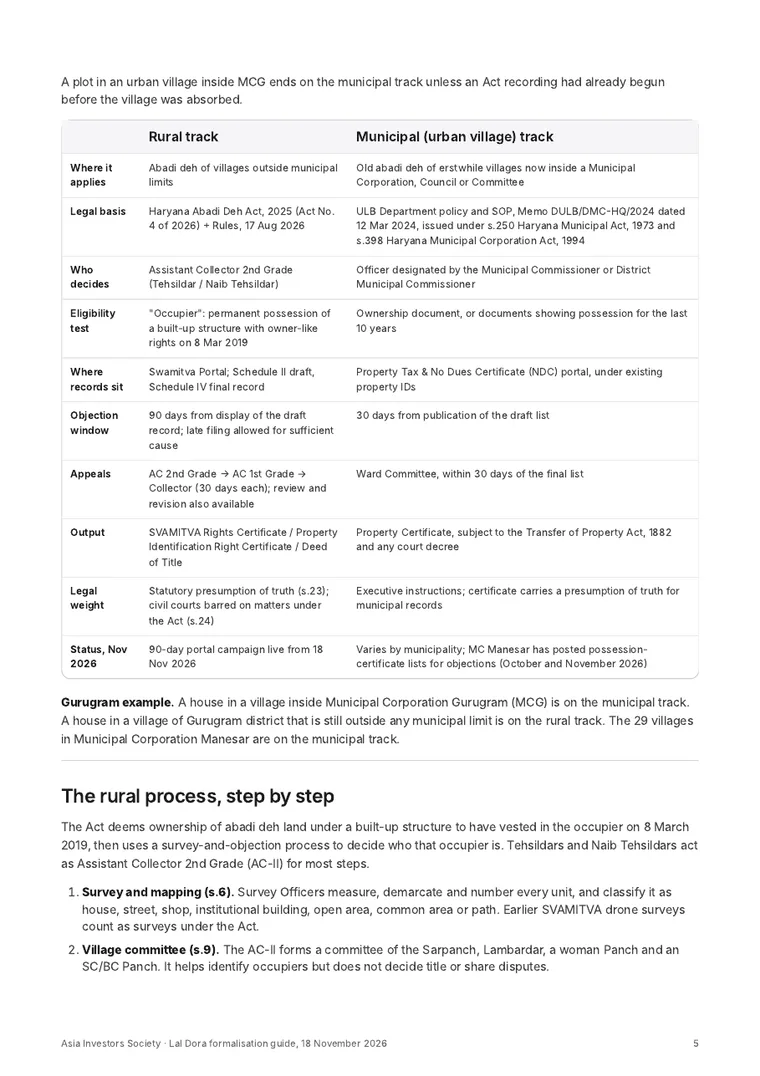
A plot in an urban village inside MCG ends on the municipal track unless an Act recording had already begun before the village was absorbed.
| Rural track | Municipal (urban village) track | |
|---|---|---|
| Where it applies | Abadi deh of villages outside municipal limits | Old abadi deh of erstwhile villages now inside a Municipal Corporation, Council or Committee |
| Legal basis | Haryana Abadi Deh Act, 2025 (Act No. 4 of 2026) + Rules, 17 Aug 2026 | ULB Department policy and SOP, Memo DULB/DMC-HQ/2024 dated 12 Mar 2024, issued under s.250 Haryana Municipal Act, 1973 and s.398 Haryana Municipal Corporation Act, 1994 |
| Who decides | Assistant Collector 2nd Grade (Tehsildar / Naib Tehsildar) | Officer designated by the Municipal Commissioner or District Municipal Commissioner |
| Eligibility test | "Occupier": permanent possession of a built-up structure with owner-like rights on 8 Mar 2019 | Ownership document, or documents showing possession for the last 10 years |
| Where records sit | Swamitva Portal; Schedule II draft, Schedule IV final record | Property Tax & No Dues Certificate (NDC) portal, under existing property IDs |
| Objection window | 90 days from display of the draft record; late filing allowed for sufficient cause | 30 days from publication of the draft list |
| Appeals | AC 2nd Grade → AC 1st Grade → Collector (30 days each); review and revision also available | Ward Committee, within 30 days of the final list |
| Output | SVAMITVA Rights Certificate / Property Identification Right Certificate / Deed of Title | Property Certificate, subject to the Transfer of Property Act, 1882 and any court decree |
| Legal weight | Statutory presumption of truth (s.23); civil courts barred on matters under the Act (s.24) | Executive instructions; certificate carries a presumption of truth for municipal records |
| Status, Nov 2026 | 90-day portal campaign live from 18 Nov 2026 | Varies by municipality; MC Manesar has posted possession-certificate lists for objections (October and November 2026) |
Gurugram example. A house in a village inside Municipal Corporation Gurugram (MCG) is on the municipal track. A house in a village of Gurugram district that is still outside any municipal limit is on the rural track. The 29 villages in Municipal Corporation Manesar are on the municipal track.
The rural process, step by step
The Act deems ownership of abadi deh land under a built-up structure to have vested in the occupier on 8 March 2019, then uses a survey-and-objection process to decide who that occupier is. Tehsildars and Naib Tehsildars act as Assistant Collector 2nd Grade (AC-II) for most steps.
- Survey and mapping (s.6). Survey Officers measure, demarcate and number every unit, and classify it as house, street, shop, institutional building, open area, common area or path. Earlier SVAMITVA drone surveys count as surveys under the Act.
- Village committee (s.9). The AC-II forms a committee of the Sarpanch, Lambardar, a woman Panch and an SC/BC Panch. It helps identify occupiers but does not decide title or share disputes.
- Draft record (s.10, Schedule II). The AC-II lists the proposed owner and boundaries of each unit as on 8 March 2019. Co-occupiers are recorded in shares. Inheritance, transfers and gifts after that date are considered if lawful and proved.
- Display (s.11). The map and draft record are shown on the government website and at public places, with a copy to the Sarpanch. Since 17 November 2026 this sits on the Swamitva Portal: choose district and village, log in with a mobile number, and view the map, drone imagery and ownership entry.
- Claims and objections (s.12(1), Schedule III). Any aggrieved person may object within 90 days of display, online or in person. The portal accepts errors in area, property classification, duplicate property IDs, and wrong or missing owner names. A Tehsil help desk assists with filing but does not decide merits.
- Hearing and decision (s.12(2) to (4)). The AC-II serves notice, hears the parties and passes a reasoned order, normally within 90 days of appearance. Corrections are entered in red ink.
- Final record (s.13, Schedule IV). An unchallenged entry becomes final. A decided objection is entered 30 days after the decision, so appeals can be filed.
- Ownership certificate (s.13(4), Rule 8). The AC-II issues a SVAMITVA Rights Certificate, Property Identification Right Certificate or Deed of Title in the name shown in Schedule IV. The state says portal certificates will be generated automatically after the 90-day period; the SOP targets generation within 15 days of the final entry.
- Mutation (s.17, Schedule V). The record goes to the Collector and the Patwari keeps a copy. Later sales, gifts, inheritance and mortgages are mutated in Schedule V.
Remedies after a decision
- Appeal: AC-II → AC 1st Grade within 30 days, then → Collector within 30 days; appeals to be decided within 60 days (s.14).
- Review: within 60 days, by the officer who passed the order, with sanction of the next higher authority (s.15).
- Revision: by the Commissioner, on application within 60 days or on his own motion (s.16).
- Partition between co-owners: consensual (s.19) or disputed (s.20); disputed cases to be decided within 90 days of notice, and may be refused if the unit cannot be divided (Rule 9).
- Clerical or arithmetical errors can be corrected at any time (s.25).
Deadline arithmetic. If your village's display date is 18 November 2026, 90 days ends on about 16 February 2027. The Act counts from the display of the draft record for each village, so confirm your village's display date at the Tehsil rather than relying on the campaign launch date.
The municipal process for urban villages (Gurugram, Manesar and other cities)
In urban villages, each municipality issues a Property Certificate to occupiers who can show ownership documents or 10 years' possession, after a public list, a 30-day objection window and a ward-committee appeal. The policy covers the old abadi deh shown under a common khasra number and generally bounded by the phirni; land carrying its own khasra number is excluded.
- Ward committee. The Municipal Commissioner (corporations) or District Municipal Commissioner (councils and committees) forms one per ward. Members: an officer of the municipality as member secretary, the elected councillor as chair, and an RWA nominee, or two residents picked at random from Family Information Data Repository data where no RWA exists.
- Boundaries and property list. The committee fixes the abadi deh boundary already mapped on the Property Tax & NDC portal, then extracts the list of properties with their owner or occupier details.
- Draft list published. The list goes on the municipality's website, with notice in one national and two local newspapers and at prominent places. Property details are also handed to each owner and occupier.
- Objections: 30 days. Anyone may object at the municipality office within 30 days of publication, on possession, area (in square metres), sub-division or anything else. If nobody objects, the published entry is treated as final.
- Hearing. The designated officer hears all affected parties and passes a speaking order within 15 days of the hearing.
- Final list. Published on the municipality's website within 30 days of resolving all claims. Common streets, wells, grounds, burial grounds and drains are recorded in the municipality's name.
- Appeal: 30 days. Any aggrieved person appeals to the Ward Committee within 30 days of the final list; the committee decides within 15 days.
- House resolution. The final list goes to the municipal House, or the Administrator if no House exists, for a resolution.
- Certificate. Records are updated on the NDC portal and the member secretary distributes printed Property Certificates. Each certificate is subject to the Transfer of Property Act, 1882 and any court decree.
Where things stand. Municipalities are moving at different speeds. Karnal uploaded 10,524 Lal Dora properties to the NDC portal for objections in late 2024, and Yamunanagar-Jagadhri began distributing certificates in December 2024. MC Manesar posted Lal Dora possession-certificate lists for objections on 29 October and 11 November 2026. We could not confirm the current stage for MCG; check the MCG website and your zone office before you rely on a date.
Building status. In a reply laid in the Haryana Assembly (covering data to July 2023), the state said abadi deh of villages merged into municipalities is treated as "regularised in situ", and that MC Manesar's area is a controlled area except the Lal Dora of its villages. That describes the settlement's status. It is not a sanction for any particular new floor or use; confirm that with the municipality and your architect.
What is covered and what is excluded
Both tracks cover built-up houses and shops inside the old red line; neither covers land outside it, public land, or building approvals.
| Item | Rural Act | Municipal policy |
|---|---|---|
| House, shop, courtyard or establishment in owner-like possession | Covered | Covered |
| Vacant plot inside the abadi | Unclear: s.3(1) wording is ambiguous; vacant Panchayat-vested abadi land stays with the Panchayat (s.3(2)) | Possession of vacant pieces to be decided "with special care" |
| Roads, paths, drains, ponds, wells, parks | Recorded to the Panchayat | Recorded to the municipality |
| Buildings of Central or State government offices | Recorded to the government or entity | Not addressed separately |
| Tenants, lessees, mortgagees, assignees, temporary possessors | Not "occupiers"; cannot be recorded as owners | Policy speaks of owners and occupiers; tenant status not addressed |
| Land outside the red line (extended Lal Dora, phirni belt, khasra land) | Not covered | Excluded ("specific khasra number land") |
| Encroachment on shamilat, Panchayat or common land | No private title by possession | Common places stay with the municipality |
| Building plan, Occupancy Certificate, permitted use (PG, shop, office) | Not covered | Not covered |
| Pending civil suits | Act is silent; civil courts barred on matters under the Act (s.24) | Certificate is subject to any court decree |
Properties "spilling outside the red line" are not unprotected; they are governed by a different regime. That land sits in the jamabandi under its khasra number, and building on it can trigger change-of-land-use, controlled-area and unauthorised-colony rules.
Documents checklist
Both tracks start from a claimant affidavit attested by a revenue authority; after that, the rural track weighs any credible evidence of occupation while the municipal track asks for two proofs covering 10 years.
Rural track (Abadi Deh Act and SOP of 12 Nov 2026)
- Claimant affidavit attested by the competent revenue authority
- Identity and address proof (Aadhaar, voter ID, passport, driving licence, PAN, ration card). These prove who you are, not what you own.
- Proof of occupation, e.g. electricity or water bills and connection records
- Property papers: sale or conveyance deed, release or relinquishment deed, court decree, or a dated photograph verified by the Patwari
- For a deceased holder: death certificate and legal-heir certificate or other succession proof, naming every heir and share
- Family ID (Parivar Pehchan Patra), since property cards are linked to it
The SOP says officers should not apply the list mechanically and may accept other legally sufficient evidence. Note: the affidavit requirement here is taken from a published law-firm summary of the SOP; confirm the exact list at your Tehsil.
Municipal track (ULB policy of 12 Mar 2024)
Mandatory
- Affidavit of the claimant, attested by the revenue authority, stating ownership or possession in the abadi deh / Lal Dora
Any two of these, covering the last 10 years
- Electricity bills
- Water bills
- Government ID showing the address (voter card, driving licence, passport, GST registration)
- Property tax receipts
- Proof of the constructed structure
Preferable, if available
- Sale or conveyance deed / registry
- Transfer, relinquishment or release deed, jamabandi or fard
- Court decree registered with the revenue authorities
- Legal-heir certificate from the revenue authority or civil court, if the original owner has died
Keep everything else too. GPAs, agreements to sell, receipts, wills and old utility files rarely prove title on their own, but they help show possession and the chain of transfer at a hearing.
Legal complexities and risks
Formalisation removes the biggest Lal Dora risk, unrecorded title. It creates new disputes over who gets recorded, and it leaves building, use, stamp-duty and tax rules exactly where they were. Where the law below is unsettled, we say so and name who to ask.
1. A title record is not a building approval
A property card or Property Certificate records who owns the land and structure. It does not approve the number of floors, the setbacks or the use, and it is not an Occupancy Certificate. Unsanctioned builder floors and PGs carry the same sealing and demolition exposure after formalisation as before. Gurugram's enforcement wings sealed PG rooms and commercial floors in licensed colonies through 2026, which shows the appetite for action on use violations.
Ask an architect or the municipality's building branch whether your structure and its use can be regularised.
2. Possession decides the record, so absentee owners are exposed
The rural Act records the "occupier": the person in permanent, owner-like possession on 8 March 2019. Tenants are excluded, but a relative, caretaker or seller still living in the house can appear as the proposed owner. An absentee buyer holding older paperwork has to object within the window and prove the claim at a hearing.
Late objections are allowed only for "sufficient cause" (s.12(1)), and the courts are strict about it. In Pathapati Subba Reddy v. Special Deputy Collector (2024), the Supreme Court held that sufficient cause is a condition precedent, and that delay can still be refused where it comes from negligence or lack of diligence. Once a matter falls under the Act, civil courts are barred (s.24) and the final entry is presumed true until disproved (s.23).
Do not plan on filing late. If you have already missed the window, ask a property lawyer before you file anything.
3. GPA, agreement-to-sell and will chains are not title
- Suraj Lamp & Industries v. State of Haryana (2011): sale agreement / GPA / will transactions do not convey title. Only a registered deed does.
- Ghanshyam v. Yogendra Rathi (2023): a buyer who paid in full and was put in possession has a possessory right protected by section 53A of the Transfer of Property Act against the seller and those claiming under him. That is still not title.
- M.S. Ananthamurthy v. J. Manjula (2025): a GPA not genuinely coupled with an interest ends on the principal's death.
The Act does not say whether a GPA buyer in possession before 8 March 2019, or the original owner's heirs, is the "occupier". Expect these cases to be contested. Post-2019 transfers are considered when the record is prepared (s.10(2) proviso), so file every document and every proof of possession at the draft stage.
Ask a property lawyer to review your chain before the hearing. Buyers: do not buy on a GPA chain in 2026. Take a registered sale deed from the recorded owner.
4. Cases already in court
The Act bars civil courts on matters under it (s.24) but says nothing about suits already pending when it came into force on 26 November 2025. The Supreme Court has held that an ouster of civil-court jurisdiction cannot retrospectively annul a decree already validly passed. Whether a suit that was still pending continues, or the dispute moves to the revenue officer, has not been decided by any court we could find.
If you already have a case in court, file an objection under the Act as well, and ask your lawyer how the two proceedings interact.
5. Co-sharers and heirs
All entitled co-owners must be recorded with their shares, and one family member's claim does not exclude the others. If a parent has died, every heir and share is verified. Buying from one heir of an undivided ancestral house means buying a share, not the house. The Act offers partition before the Assistant Collector (ss.19 to 21), which can avoid a civil partition suit, but it can be refused where the unit cannot be divided.
Ask a lawyer before buying any share of a family house, and ask your CA or lawyer about stamp duty on partition, release or relinquishment deeds between relatives: we could not verify the current rates.
6. Empty plots inside the red line are the riskiest buy
Section 3(1) lists "vacant land, plot" among the things that vest in the occupier, but the Act defines an occupier by possession of a built-up structure. Vacant abadi land vested in the Panchayat stays with the Panchayat (s.3(1) proviso, s.3(2)), and survey units recorded as "open area" can invite a Panchayat claim. An empty plot may also need a Section 7A NOC to register (see point 9). Whether a private, free-standing empty plot vests at all is the least clear point in the Act.
For houses built on shamilat land before 31 March 2004, Haryana has a separate route to buy the land from the Gram Panchayat (up to 500 sq yd, at 1.5 times the 2004 collector rate, after Panchayat and Gram Sabha resolutions).
Before paying for an empty plot, ask a property lawyer to check the Panchayat's shamilat record and the plot's classification in the draft record.
7. Panchayat, shamilat and common land overlap
Paths, ponds, drains and vacant Panchayat land are recorded to the Panchayat or municipality. A house that has spread onto a street or a pond edge will be recorded smaller than its physical footprint, and the excess remains exposed to removal. Check the classification of every adjoining survey unit.
8. Land outside the red line
Plots in the extended Lal Dora or phirni belt carry khasra numbers and follow ordinary revenue law. They may be agricultural land needing change of land use (CLU), or part of an unauthorised colony. Neither the Act nor the municipal policy will convert them. Ask a lawyer and a town-planning consultant before buying.
9. Registration: Section 7A NOC and the No Dues Certificate
- Section 7A NOC. Under section 7A of the Haryana Development and Regulation of Urban Areas Act, 1975 (as amended in 2020), registering a sale, lease or gift of vacant land under one acre in a notified urban area needs a no-objection certificate from the Director, Town and Country Planning. It is deemed granted if not decided within 30 days. "Vacant land" means land with no construction, or a structure that is uninhabited, unfit to live in, or built without following the law. A 2026 amendment adds exchange deeds, deemed effective from 30 January 2026 (we saw the Bill; the enacted Act number is unconfirmed).
- What that means for Lal Dora. A built-up, lived-in house is usually outside 7A. An empty plot, or an uninhabited unauthorised structure, may not be. We found no circular or High Court ruling specific to Lal Dora.
- No Dues Certificate (NDC). In municipal areas, section 99A of the Haryana Municipal Act, 1973 and section 96A of the Haryana Municipal Corporation Act, 1994 bar registration of any sale, gift, lease or transfer without a no-dues certificate, valid for three months. In practice it is generated against the property ID.
- Neither a SVAMITVA certificate nor a municipal Property Certificate waives the NOC or the NDC.
Ask your lawyer and the sub-registrar's office (Wazirabad, Badshahpur, Harsaru, Kadipur or Manesar for Gurugram) what they will require for your specific deed.
10. The two tracks carry different legal weight
The rural record rests on a statute with a presumption of truth (s.23) and a civil-court bar (s.24). The municipal certificate rests on executive instructions and is expressly subject to the Transfer of Property Act and court decrees. The Supreme Court has repeatedly held that revenue and mutation entries are fiscal records that do not create title (Suraj Bhan v. Financial Commissioner, 2007; Jitendra Singh v. State of M.P., 2021).
So the municipal certificate is strong evidence of possession, not a statutory title, and a rival claimant can still go to civil court. No High Court has yet ruled on its weight, and we found no proposal to extend the Act to municipal areas.
For an urban-village purchase, ask a property lawyer for a full chain-of-title check even when the seller holds a certificate.
11. Data errors
The portal's own objection categories are the common errors: wrong area, wrong classification (residential vs commercial vs vacant), duplicate property IDs, and missing or misspelt owners. Each one can block a sale, a loan or a mutation later. Fix them now, while the process is open.
Buying or investing: due diligence and pricing the discount
A Lal Dora plot priced well below the licensed sector across the road is rarely mispriced. Formalisation closes only the part of the gap that comes from unrecorded title; the rest comes from building, use, access and financing constraints that a property card does not touch.
What drives the discount, and what formalisation fixes
| Driver of the discount | Closed by formalisation? | What to check |
|---|---|---|
| No recorded title | Yes, once the final record or certificate is in the seller's name | Schedule IV entry or municipal final list; certificate number |
| Disputed or unclear seller (heirs, GPA chain) | Partly; disputes surface in the objection process | Objections filed or pending; every heir's share |
| No bank finance | Partly; loans are being sanctioned but at low volume | Lender's written in-principle view on the specific property |
| Unsanctioned floors or use (builder floors, PGs, shops) | No | Sanctioned plan, OC, any sealing or demolition notice |
| Narrow lanes, no setbacks, no parking, density | No | Site visit; road width; fire access |
| Encroachment onto common land | No; the excess is recorded to the Panchayat or municipality | Survey map vs physical footprint |
| Thin resale market | Slowly, if registrations and loans scale | Registered sales in the same village; only 51 post-registration sales reported statewide so far |
Pre-purchase checklist
- Confirm which track applies: is the village inside municipal limits today, and did an Act process start before inclusion?
- Pull the property's record: Swamitva Portal (rural) or the municipality's list / NDC portal (urban).
- Match name, parentage, survey unit or property ID, area, dimensions, boundaries and classification to the seller's papers.
- Check whether the objection window is open, closed, or has pending objections or appeals on this unit or its neighbours.
- Insist on the final entry (Schedule IV) or final-list certificate. A draft entry or present possession is not enough to issue a certificate, and should not be enough for you to pay.
- Get every co-owner and heir to sign, or a registered release deed in favour of the seller.
- Compare the drone map with the physical footprint; walk the boundaries.
- Ask for the sanctioned building plan and OC, or price the structure as at risk.
- Check for sealing, demolition or show-cause notices, and current use (PG, shop, office).
- Pay through a registered sale deed only after the record is final; avoid GPA or agreement-to-sell structures.
- Get a lender's view before you commit if you plan to finance or exit to a financed buyer.
- Have your lawyer review title and Section 7A, and your CA review stamp duty and capital-gains basis.
Owners: what to do in the 90-day window
Check your entry in the first two weeks, not the last two; an error found early can be fixed by objection, one found late may need an appeal.
- Find your record. Rural: Swamitva Portal, select district and village, log in with the mobile number linked to your family ID. Urban: your municipality's website or the NDC portal, by property ID.
- Check six things: owner names and parentage, every co-owner and share, area, dimensions and boundaries, classification (residential, commercial, mixed, vacant), and that only one property ID exists for your unit.
- Collect evidence using the checklist above. Get the affidavit attested early; it is the step most likely to queue.
- File the objection within the window, with documents attached: on the portal or at the Tehsil help desk (rural), or at the municipality office (urban). Keep the acknowledgement.
- Attend the hearing. Bring originals. If a neighbour or relative objects to your entry, you are a party too; answer the notice.
- Track the order. If it goes against you, appeal within 30 days. Rural: to the AC 1st Grade. Urban: to the Ward Committee.
- After the final entry, download or collect the certificate, check it against the final record, and update the family ID, property tax and electricity records to match.
If you live away from the property (NRI, another city, inherited house), log in now or act through an attorney. The occupier in the house is the person the process is designed to find. For a power of attorney signed abroad:
- Sign a specific power of attorney that expressly covers filing objections and appearing in Abadi Deh Act or municipal proceedings.
- Execute it before an Indian embassy or consulate, or have it notarised and apostilled in a Hague Convention country.
- Get it stamped in Haryana within three months of it first reaching India (section 18, Indian Stamp Act).
- Remember that a power of attorney never transfers ownership, and it ends on the owner's death unless it is genuinely coupled with an interest.
Ask a lawyer to draft it: stamp duty on a power of attorney depends on whether it authorises a sale, for consideration and to whom, and we have not verified the current Haryana rates.
Bank loans against Lal Dora property
Formalisation has made Lal Dora property bankable in principle, but lending is still thin: 2,541 loans against 4,21,727 registered properties is about 0.6% (our arithmetic on the state's November 2026 figures).
Expect a lender to ask for:
- the final ownership certificate or municipal Property Certificate in the borrower's name;
- a registered title deed for any transfer after the record was made, plus mutation;
- a clearly demarcated, built-up property matching the survey map;
- property ID, property tax and no-dues records;
- in many cases, a building plan or valuation that accepts the structure as it stands.
Policies differ by bank and housing finance company, and many have no published Lal Dora policy. Get the lender's view in writing for the specific property before you price an exit on financed buyers.
Stamp duty, capital gains and GST
Formalisation is not a tax or stamp-duty holiday: issuing the certificate costs no stamp duty, but every later sale is taxed and stamped in full, and the certificate does not reset your capital-gains position.
Stamp duty and registration
- Issuing the certificate: neither the Act nor the municipal policy charges stamp duty on the SVAMITVA Rights Certificate or the Property Certificate. It is a record made by an officer, not a deed between parties.
- Later sales and gifts: charged in full under the Indian Stamp Act, 1899 as applied in Haryana. In urban areas the duty is 7% for men and 5% for women, including a 2% component; the Chief Minister said in 2025 that these rates have been unchanged since 2008.
- The base: the higher of the deal value and the collector rate. Under section 47-A the Collector can reassess an undervalued deed.
- Collector rates: Gurugram's 2026-27 rates apply from 1 April 2026, with separate schedules for each tehsil (Gurugram, Badshahpur, Wazirabad, Sohna, Manesar, Pataudi, Kadipur, Harsaru, Farrukhnagar). We could not confirm whether they list Lal Dora or abadi areas separately; where they do not, sub-registrars are reported to apply the surrounding locality's rate.
- Not verified: rural and joint-ownership rates and the current registration-fee schedule are quoted inconsistently across secondary sources, so we have not printed them.
Ask your CA or the sub-registrar's office for the rural or joint rate, the registration fee, and the collector rate they will apply to your plot before you budget a deal.
Capital gains
- Holding period: land and buildings held for more than 24 months are long-term.
- Rate: long-term gains on transfers from 23 July 2024 are taxed at 12.5% without indexation. For land or buildings acquired before 23 July 2024, resident individuals and HUFs can choose the lower of 12.5% without indexation and 20% with indexation. The Income-tax Act, 2025, in force from 1 April 2026, carries this forward under renumbered sections.
- Inherited property: the previous owner's cost and holding period carry over.
- Does the certificate reset anything? In our view it should not, because the Act records rights the occupier already had (vesting is deemed from 8 March 2019). The tax department has issued no specific guidance, and the view is weaker for someone whose only right was possession.
- GPA and agreement-based purchases: tribunals disagree on whether the holding period starts at the agreement, possession or registered deed. The answer can turn a long-term gain into a short-term one.
- TDS: a buyer of immovable property worth ₹50 lakh or more deducts 1% TDS (section 194-IA of the 1961 Act; the 2025 Act has a corresponding provision).
Ask your CA before you sell, gift or restructure a Lal Dora holding, especially if it was inherited or bought on a GPA. Keep every old agreement, inheritance paper, house-tax and electricity record: they will matter more for tax than the certificate date.
GST on builder floors and PGs
- Completed, occupied house or plain land: outside GST.
- Floors sold before completion: construction for sale is a taxable service unless the entire price is received after the completion certificate (where one is required) or after first occupation, whichever is earlier. Many Lal Dora floors have no OC, and advance rulings have leaned against developers who could not show completion.
- PG and hostel accommodation: exempt only up to ₹20,000 per person per month for stays of at least 90 continuous days (from 15 July 2024). Renting a residential dwelling to a GST-registered business has attracted GST under reverse charge since 18 July 2022.
- Joint development with a landowner: GST on development rights can apply; we found no Lal Dora-specific ruling.
Ask a GST practitioner or your CA before you build floors for sale or run a PG on Lal Dora property.
When to call a lawyer, CA or other expert
The points below are unsettled, fact-specific or depend on office practice that changes. Treat this guide as a checklist for those conversations, not a substitute for them.
| Question | Who to ask | Why it is not settled |
|---|---|---|
| Whether you or a seller's heirs will be recorded on a GPA / agreement chain | Property lawyer | The Act does not say how "occupier" applies to GPA buyers |
| What happens to a civil suit that was pending on 26 Nov 2025 | Property lawyer | No express rule on pending suits; no court ruling yet |
| Whether a late objection will be accepted | Property lawyer | "Sufficient cause" is discretionary and strictly applied |
| Whether an empty Lal Dora plot can be recorded in private ownership | Property lawyer | Section 3(1) wording is ambiguous; Panchayat claims possible |
| How much a municipal Property Certificate is worth in a dispute | Property lawyer | Executive instructions, subject to court decrees; no High Court ruling yet |
| Whether your deed needs a Section 7A NOC | Lawyer and sub-registrar's office | Depends on "vacant land" status and notification; no Lal Dora circular |
| Stamp duty, registration fee and collector rate for your plot | CA or sub-registrar's office | Rural, joint and fee figures not verified; abadi rates may not be listed |
| Stamp duty on partition, release or relinquishment among family | CA or lawyer | Current rates not verified |
| Capital-gains cost, holding period and TDS | CA | No CBDT guidance on formalisation; GPA acquisition date disputed |
| GST on builder floors, joint development or PG income | GST practitioner or CA | "Completion" is hard to prove without an OC |
| Whether a building or its use can be regularised | Architect and municipal building branch | Title records do not approve buildings |
| Power of attorney from abroad for the proceedings | Lawyer | Form, stamping and scope must fit both the Act and the sub-registrar |
How Delhi and UP compare
Haryana is furthest ahead in NCR: its whole rural Lal Dora is surveyed and backed by a statute, while Delhi is still issuing its first cards and UP has a statute but a different, Gharauni-based record.
| Haryana | Delhi | Uttar Pradesh (incl. Noida, Ghaziabad villages) | |
|---|---|---|---|
| Law | Haryana Abadi Deh Act, 2025 (Act 4 of 2026) + Rules 2026; ULB policy 2024 for municipal areas | No dedicated Lal Dora statute yet; Delhi Land Records Bill, 2026 proposed ("Property Aadhaar" card for every property) | Uttar Pradesh Rural Abadi Records Act, 2025 (U.P. Act 4 of 2026), assented 2 Jan 2026 |
| Record issued | SVAMITVA Rights Certificate / property card; municipal Property Certificate | QR-enabled smart property card under SVAMITVA | Gharauni (rural abadi ownership record) |
| Coverage, latest reported | 6,248 villages surveyed; 25,16,190 cards prepared | 48 villages under SVAMITVA; surveys done in 30; 12,232 properties surveyed, 8,423 dispute-free and eligible (Jul 2026) | Over 1.06 crore Gharaunis prepared, 1.01 crore distributed (as of May 2025) |
For Delhi and UP we report coverage only; check the current procedure locally before acting on a property there.
Frequently asked questions
What is the Lal Dora 90-day campaign in Haryana?
It is a statewide window, from 18 November 2026, for residents of rural Lal Dora villages to view their property records on the Swamitva Portal and file claims or objections. It runs under the Haryana Abadi Deh Act, 2025. Ownership cards are to be generated after the window closes.
Does the campaign cover urban villages in Gurugram?
Generally no. The Act covers abadi deh outside municipal limits. Urban villages inside MCG, MC Manesar and other municipalities follow the Urban Local Bodies policy of 12 March 2024, unless an Act process had already started before the village entered municipal limits.
What is the cut-off date for Lal Dora ownership in Haryana?
For the rural Act it is 8 March 2019, the date of the Haryana and Survey of India MoU. The occupier on that date is the starting point; lawful, proved inheritance, gifts and transfers after it are then considered. The municipal track instead asks for 10 years' proof of possession.
Is a SVAMITVA property card the same as an Occupancy Certificate?
No. The card records ownership of the land and structure. It does not sanction the building, its floors or its use, and it does not protect an unsanctioned builder floor or PG from sealing.
Can I sell or mortgage Lal Dora property after I get the certificate?
Yes. Sales and gifts go through a registered deed and are mutated in the record, and banks have begun lending: 2,541 loans had been sanctioned by November 2026. Lender policies vary, so check with the specific lender.
What if I miss the 90-day objection window?
The Act allows late objections for sufficient cause, and appeal (30 days at each level), review (60 days) and revision remain. But the civil court route is barred for matters under the Act, so missing the window makes correction harder and slower.
I bought on a GPA. Will I be recorded as the owner?
Possibly, if you were in permanent, owner-like possession on 8 March 2019 or acquired lawfully and provably afterwards. A GPA by itself does not convey title under Supreme Court law. Get a lawyer to assess your chain before the hearing.
Are tenants given ownership?
No. Under the rural Act, tenants, lessees, mortgagees, assignees and people in temporary possession are not "occupiers" and cannot be recorded as owners.
What about land outside the red line?
Extended Lal Dora and phirni-belt land carries khasra numbers and follows ordinary revenue law. Neither the Act nor the municipal policy covers it.
Who decides objections?
Rural: the Assistant Collector 2nd Grade (Tehsildar or Naib Tehsildar), with appeals to the Assistant Collector 1st Grade and then the Collector. Urban: an officer designated by the municipality, with appeal to the Ward Committee.
What documents do I need?
An affidavit attested by a revenue authority, identity proof, and evidence of possession or ownership. The municipal track specifically asks for any two proofs covering 10 years, such as electricity bills, water bills or property tax receipts. See the documents checklist.
Is there a fee to file an objection?
The Act contains no fee provision, and the reports we reviewed mention none. Mutation fees are left to rules. Confirm at your Tehsil or municipality.
How is Haryana's process different from Delhi's?
Haryana has a dedicated statute and has surveyed all 6,248 rural Lal Dora villages. Delhi had brought 48 villages under SVAMITVA by July 2026 and is preparing a broader Land Records Bill.
How much stamp duty is payable when I sell Lal Dora property?
Issuing the certificate attracts no stamp duty, but a later sale is stamped in full. In Haryana's urban areas that is 7% for men and 5% for women, on the higher of the deal value and the collector rate. Confirm rural or joint rates, the registration fee and the collector rate for your plot with your CA or the sub-registrar's office.
Does getting the certificate reset my capital gains?
In our view, no: the Act records rights you already had, so your original cost and holding period should continue. There is no specific tax-department guidance yet, and GPA purchases are disputed. Ask your CA before you sell.
Do I need a Section 7A NOC to register a Lal Dora sale?
Only if the property is "vacant land" under one acre in a notified urban area. A built-up, lived-in house is usually outside it, but an empty plot may not be. Ask your lawyer and the sub-registrar's office, and remember that municipal areas also need a No Dues Certificate.
I already have a court case over a Lal Dora house. What should I do?
File an objection under the Act within the window as well, and tell your lawyer. The Act bars civil courts on matters under it but does not say what happens to suits that were already pending, and no court has ruled on it yet.
Is it safe to buy an empty Lal Dora plot?
It is the riskiest kind of Lal Dora purchase. Vacant abadi land vested in the Panchayat stays with the Panchayat, it is unclear whether a private empty plot vests at all, and a Section 7A NOC may apply. Have a property lawyer check the Panchayat record and the draft entry before you pay.
Glossary
| Term | Meaning |
|---|---|
| Abadi deh | Inhabited site of a village recorded as such and not assessed to land revenue |
| Appointed day | 8 March 2019; the rural Act's reference date for who owns what |
| Assistant Collector 2nd Grade (AC-II) | Revenue officer (Tehsildar / Naib Tehsildar) who prepares the record, hears objections and issues certificates |
| Extended Lal Dora / phirni | Area beyond the original red line, up to the village ring road; usually khasra land under ordinary revenue law |
| Jamabandi / fard | Haryana's record of rights for revenue land, and a certified copy of it |
| Khasra number | Survey number of a revenue field; Lal Dora houses usually have none |
| Lal Dora / lal lakir | Red line on revenue maps marking the village's inhabited core |
| Mutation (intkal) | Change of name in the land record after a sale, gift or inheritance |
| NDC portal | Haryana ULB Property Tax & No Dues Certificate portal, which holds municipal property IDs |
| Occupier | Under the rural Act, a person in permanent, owner-like possession of a built-up structure; excludes tenants, lessees, mortgagees, assignees and temporary possessors |
| Parivar Pehchan Patra (PPP) | Haryana's family ID, to which property cards are linked |
| Schedule II / III / IV / V | Draft record / objection form / final record / mutation register under the rural Act |
| Shamilat deh | Village common land vested in the Panchayat |
| SVAMITVA | Survey of Villages and Mapping with Improvised Technology in Village Areas, the central drone-survey scheme launched in 2020 |
| Swamitva Portal | Haryana's online portal (launched 17 Nov 2026) to view rural Lal Dora records and file objections |
| Ward Committee | Municipal committee that fixes Lal Dora boundaries and hears appeals on the urban track |
Legal references and sources
Primary law and policy
- Haryana Abadi Deh (Vesting, Recording and Resolving of Ownership Rights) Act, 2025: Haryana Act No. 4 of 2026 (PRS copy)
- Haryana Abadi Deh Ordinance, 2025: Ordinance No. 6 of 2025 (PRS copy)
- Abadi Deh Bill No. 38-HLA of 2025 (Haryana Vidhan Sabha)
- ULB Haryana: Property Certificate to occupiers of properties in Abadi Deh / Lal Dora of municipal areas: policy and SOP, 12 Mar 2024
- Uttar Pradesh Rural Abadi Records Act, 2025 (India Code)
- Haryana Assembly reply on merged villages and MC Manesar controlled area
Reporting and secondary sources
- The Tribune: Ownership rights for Lal Dora residents from tomorrow (Nov 2026)
- The Tribune: Haryana rolls out portal for 25 lakh Lal Dora properties (Nov 2026)
- Millennium Post: CM launches Swamitva Portal for Lal Dora grievances (Nov 2026)
- The Tribune: Haryana notifies rules to implement Abadi Deh law (Aug 2026)
- The Tribune: Abadi Deh Ordinance grants ownership rights (Nov 2025)
- Lawyers in Gurgaon: Abadi Deh Act 2025 and Rules 2026 explained and Abadi Deh SOP 2026 (law-firm summaries)
- MC Manesar: Lal Dora possession-certificate lists for objections
- The Tribune: Karnal MC uploads 10,524 Lal Dora properties
- The Tribune: Yamunanagar Lal Dora certificates
- NewKerala/IANS: Delhi Lal Dora villages to get digital property records (Jul 2026)
- Business Today: Delhi Land Records Bill 2026
- The Statesman: UP Rural Abadi Records Bill and Gharauni figures
- Business Today: DTCP seals floors in DLF Phase 4 (Jul 2026)
Judgments, registration, stamp duty and tax
- Haryana Development and Regulation of Urban Areas (Second Amendment and Validation) Act, 2020: Section 7A (PRS copy) and Bill No. 6-HLA of 2026 adding exchange deeds
- The Tribune: stamp duty rates unchanged since 2008; waiver on small housing-scheme plots
- Gurugram tehsil collector rates 2026 (ULB Haryana)
- Haryana Assembly reply on property ID and No Dues Certificate
- The Tribune: houses on shamlat deh built before 2004 can be bought from the Panchayat
- Ghanshyam v. Yogendra Rathi (2023): summary
- M.S. Ananthamurthy v. J. Manjula (2025): LiveLaw report
- Pathapati Subba Reddy v. Special Deputy Collector (2024): Verdictum report
- Bar & Bench: ouster of civil-court jurisdiction cannot annul a decree already passed
- Income Tax Department: tax on long-term capital gains
- State of Karnataka v. Taghar Vasudeva Ambrish (2025) on GST and hostels: Verdictum report
- India IP Office table of state stamp duty on powers of attorney
Not yet confirmed: the Swamitva Portal's web address was not published in the reports we reviewed; ask your Tehsil for the official link and avoid look-alike sites. MCG's current stage on the municipal track is unconfirmed. We could not read the full text of the 2026 Rules or the 12 November 2026 SOP ourselves; items drawn from practitioner summaries, and the rural, joint, registration-fee, partition and power-of-attorney stamp rates, are marked for confirmation with a lawyer or CA.
Disclaimer. This guide is general information as of 18 November 2026, compiled by Asia Investors Society from the sources above. It is not legal, tax or investment advice, and reading it does not create an adviser relationship. Several points are unsettled or depend on local office practice; we have marked them and named who to ask. Laws, rules, rates and portal procedures change. Confirm every step with the competent revenue or municipal office, and take any specific transaction to a qualified property lawyer and chartered accountant before you sign or pay.
Looking at a Lal Dora or urban-village asset?
We verify who can sell an asset before it reaches capital. If you are buying, selling or financing property in an abadi area, talk to us before you sign.
Discuss a transaction